
Smartphone Visual Fish Finders: Category Upgrade at the Intersection of Sonar, Optics and AI
In 2026, competition in smartphone visual fish finders has shifted from “is there a picture” to “is the picture useful.” Overseas high-end live sonar continues to raise the experiential ceiling, while the castable-sonar-plus-app route brings on-device AI, 2D/3D vegetation mapping, and bottom-hardness mapping into the consumer segment. China’s supply chain, moving at consumer-electronics speed, has pushed smartphone visual products into the USD 50–150 band, with underwater robotic form factors and Wi-Fi direct-to-phone live sonar making concentrated appearances. An industry consensus is forming: the phone app is no longer a mere display but the central node for mapping, data, AI identification, and decision support.
I. Market Overview: Incremental Logic Shifts from “Device Ownership” to “Information Utility”
The global portable fish finder market was about RMB 935 million in 2025 and is projected to reach RMB 1.283 billion by 2032 at a CAGR of 4.62%, with “smartphone-type” devices tracked as a distinct category. The wireless underwater fishing camera segment is growing faster: roughly USD 350 million in 2025, projected to USD 800 million by 2035 at a CAGR of 8.6%, with Asia-Pacific as the fastest-growing region. North America remains the largest regional market; portable cameras account for about 60% of wireless underwater cameras, and Wi-Fi about 55% of connectivity. The overall fish finder market is projected to grow from USD 630 million in 2026 to USD 1 billion by 2035, at a CAGR of about 5.2%. The headline rate is moderate, but the structural shift matters more: incremental demand no longer mainly comes from device penetration, but from whether a device can translate the underwater world into actionable information.
II. Overseas Dynamics: Live Sonar and Castable AI Sonar “Advancing on Two Poles”
Overseas, technological divergence is clear. At one pole, high-end live-scanning sonar products launched in 2026 raise resolution by roughly 20% and range by about 25%, eliminate the separate black box, and connect transducers directly to multifunction displays, significantly reducing installation complexity. These products do not center on the smartphone as the primary display, but they define the experiential ceiling of real-time sight of fish-lure interaction. At the other pole, the castable-sonar-plus-app route saw lightweight products in 2026 featuring on-device AI assistance that distinguishes fish from noise and vegetation in real time and generates 2D/3D vegetation and bottom-hardness maps, with data accumulating in the app. Competitive gravity is shifting from hardware specs toward app-side mapping, data, and community features.
III. Domestic Dynamics: Consumer-Electronics Logic and Supply-Chain Price Reshaping
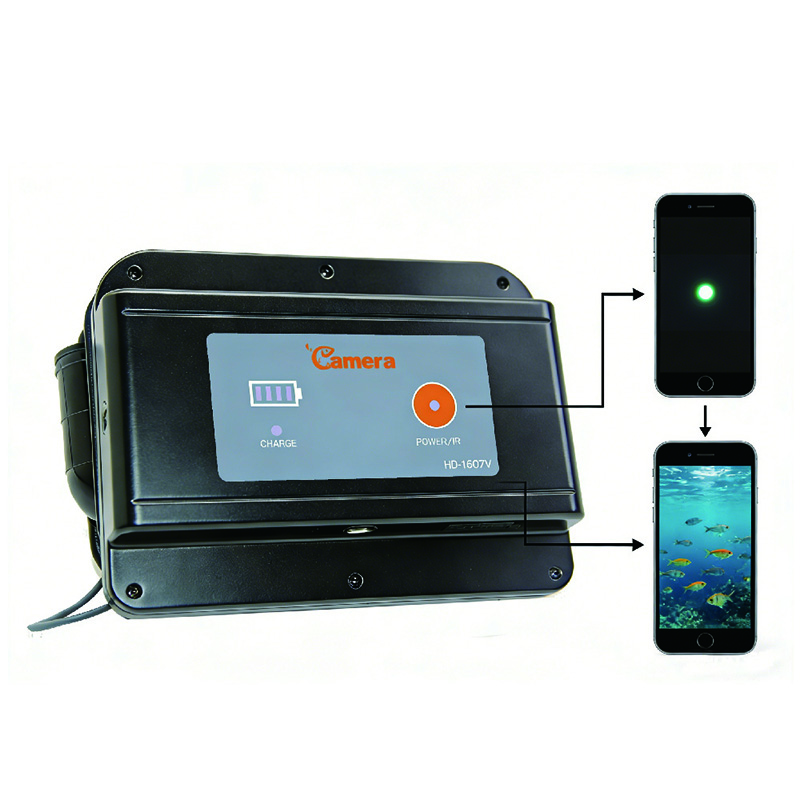
Chinese manufacturers are entering along a different path from overseas incumbents: using consumer-electronics speed and cost discipline to push smartphone visual products into the USD 50–150 handheld/phone-accessory band, with Wi-Fi direct-to-app presentation of depth, water temperature, terrain, and fish activity. Another differentiated route comes from underwater robotics spillover, with 360° rotatable cameras, Wi-Fi real-time return, and AI scouting entering fishing scenarios. At 2026 domestic lure expos, local brands showcased Wi-Fi direct-to-phone/tablet real-time dynamic sonar, with “black-tech” upgrades becoming the main line of equipment evolution. Within this supply chain, a group of small and mid-sized Shenzhen manufacturers — including Shifengda Technology — has long carried R&D and manufacturing for underlying modules such as underwater imaging, data fusion, and export compliance, forming a technical chassis layer that is easy to overlook but hard to bypass.
IV. Technology Trends: Three Paths Converging, the Smartphone as Central Node
The category sits at the intersection of three technology paths. Sonar is moving toward CHIRP, real-time imaging, and AI; single-beam sonar is giving way to CHIRP, live sonar, and 3D visualization. Optics is moving from visibility to clarity and interpretability, as HD and low-light night vision trickle down and make close-range species and bait confirmation feasible. The robot/drone path turns the camera from a fixed probe into an actively searching, 360°-viewing underwater platform. All three converge on one destination: the phone app is no longer a mere display but the central node for mapping, waypoint cloud sync, AI identification, and decision support. Industry analysis already treats “sonar + optical imaging + AI species identification” as the mid-to-high-end standard, and app-side mapping, data, and community capabilities as the key to retention.